
An AI companion is conversational AI designed for an ongoing, personalized interaction with a user rather than only completing one-off tasks. It typically combines natural-language conversation with a persistent persona and some form of continuity across interactions. Depending on the product, an AI companion may also support custom characters, memory, voice, images, or other ways to make the interaction feel consistent over time.
That ongoing relationship is the important distinction. A customer-service bot may answer a question about an order. An AI assistant may summarize a document or help write an email. An AI companion is designed so that the conversation itself — and the character you are talking with — can matter from one interaction to the next.
That does not mean an AI companion is a person or that fluent, emotional language proves consciousness. It is software generating responses through AI models and product systems.
AI companion vs chatbot vs AI assistant
The terms overlap, so the cleanest way to distinguish them is by what the product is designed to do.
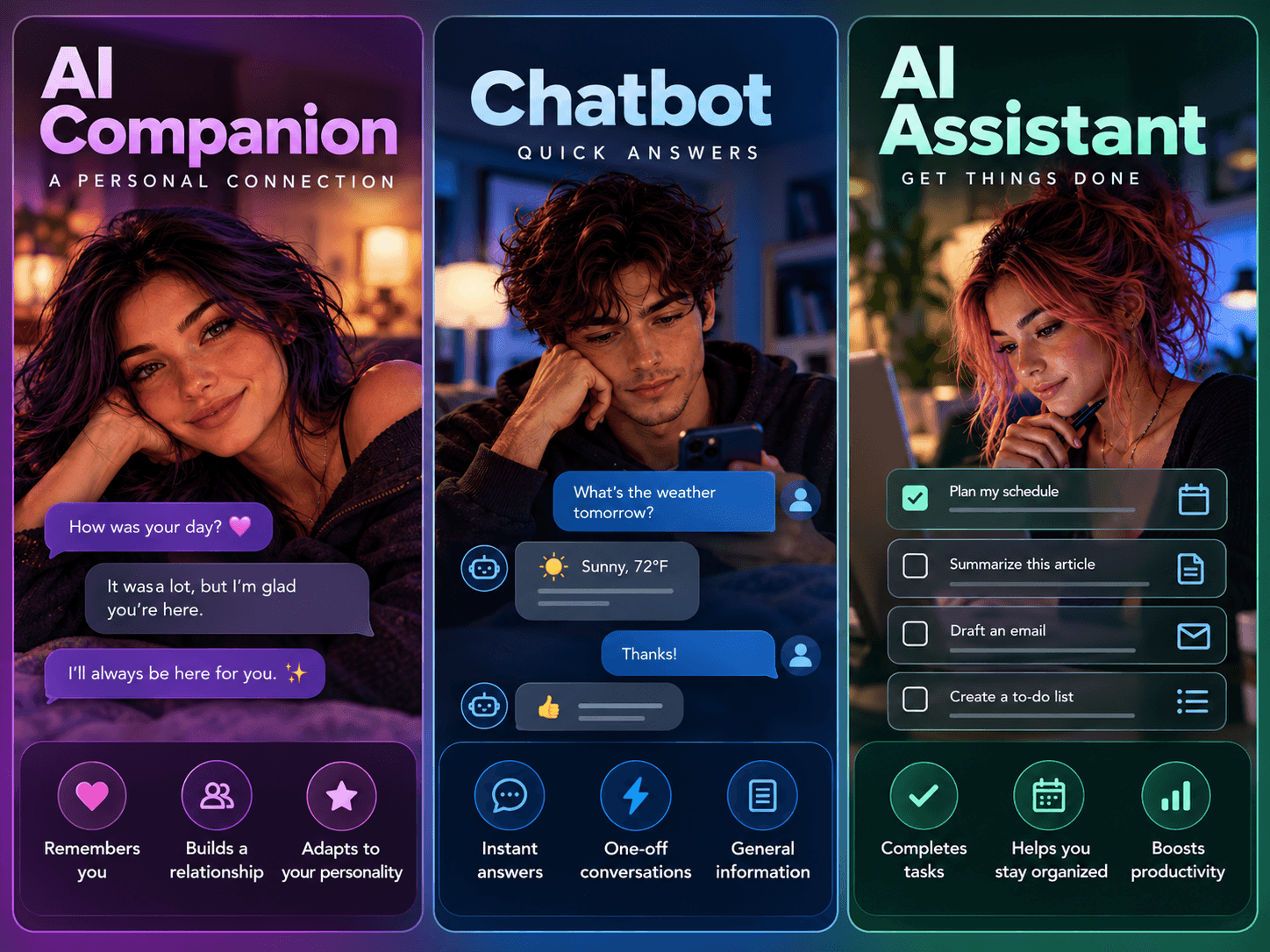
| Type | Primary purpose | Typical interaction |
|---|---|---|
| Traditional chatbot | Handle a narrow conversation or workflow | Answer support questions, collect information, guide a transaction |
| AI assistant | Help accomplish tasks or find answers | Research, writing, analysis, planning, coding, productivity |
| AI companion | Create an ongoing personalized conversational experience | Recurring conversations with a persistent persona, character, or relationship context |
These are product-design distinctions, not perfect technical boundaries. A general-purpose assistant can sound personable, and a companion can answer factual questions. The difference is what the experience is optimized around.
In fact, companion AI is becoming distinct enough that some U.S. laws now define the category separately from customer-service and productivity tools. Definitions vary, but sustained interactions and adaptive, human-like conversation are recurring themes.
How does an AI companion work?
Most AI companions are built from several layers working together.
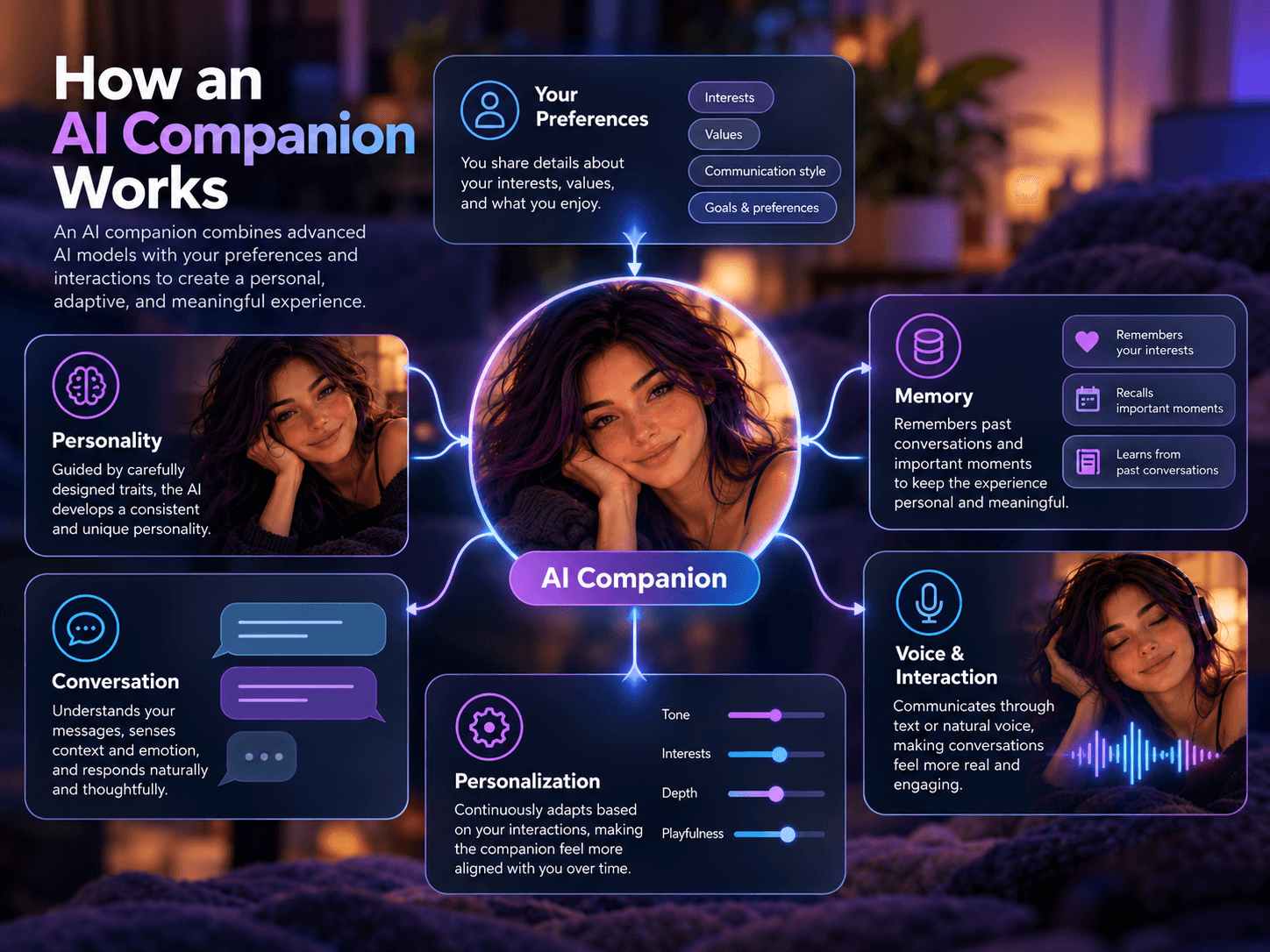
1. A language model generates the conversation
At the center is usually a large language model, or LLM. It interprets what you write or say and generates a response based on the conversation, instructions supplied by the product, and whatever context the system provides.
The model is what makes open-ended conversation possible. But the model alone does not define the companion.
2. A persona gives the companion an identity
Companion products typically add instructions describing who the character is and how they should behave. That can include personality, conversational style, interests, backstory, boundaries, or the role the character is meant to play.
Some platforms provide prebuilt characters. Others let you create your own.
For example, MyBot lets users design characters with their own personality, appearance, voice, conversation style, and content preferences. You can select an AI model during character creation when using Classic voice mode. Natural Voice does not offer a model selector, and the selected model cannot be changed after the character is created. Characters can be kept private or published for other people to chat with.
3. Memory can create continuity
Without memory, even a convincing character can feel like it is meeting you again every time you start a new conversation.
Memory systems attempt to carry useful context forward: details you have shared, preferences, previous events, or other information relevant to future conversations. Different products handle this differently, so "has memory" does not necessarily mean every message is stored or perfectly recalled forever.
On MyBot, Deep Memory helps characters carry relevant details across conversations. It combines creator-defined World Memory, Character Facts, and information automatically learned from what users share in About You.
4. Voice and media can make the character more expressive
Text is only one interface. Some companion platforms add real-time voice conversations, generated images, avatars, or other media.
MyBot supports both text and voice conversations. These features do not make the underlying AI more human; they simply change how you interact with the character.
What do people use AI companions for?
There is no single companion use case. Because the interaction can be shaped by a persona, the same underlying product category can support very different experiences.
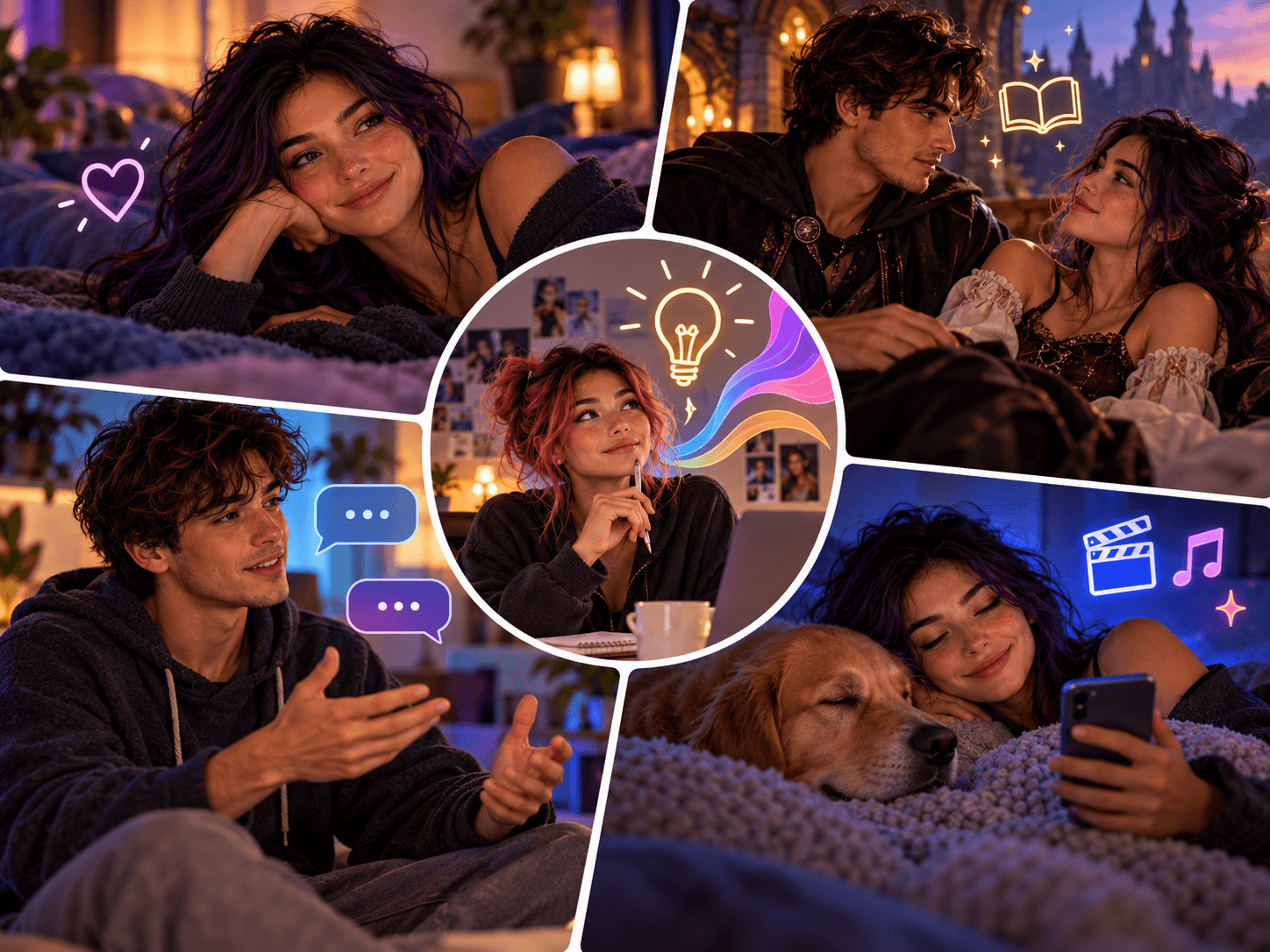
A character might be designed as:
- a companion to chat with about your day;
- a storyteller for roleplay or collaborative fiction;
- a tutor for practicing a language or exploring a topic;
- a muse for brainstorming ideas;
- a mentor-style character for talking through a decision;
- a sparring partner that challenges your thinking;
- or simply a fictional personality you enjoy talking to.
Those examples describe conversational use cases, not professional services. An AI character should not be treated as a substitute for a doctor, therapist, lawyer, financial adviser, or other qualified professional when expert help is needed.
Are AI companions conscious or actually feeling emotions?
There is no reason to assume that an AI companion's human-like language means it is experiencing the emotions it describes.
Modern language models can produce remarkably natural dialogue. A character can say it is excited to hear from you, remember something you mentioned earlier, or respond empathetically to a difficult story. Those behaviors can make an interaction feel socially meaningful to a user, but the generated language itself is not evidence that a person is on the other side of the conversation.
A useful mental model is: the character experience can be meaningful without pretending the software is human.
Is an AI companion the same as an AI girlfriend or boyfriend?
Not necessarily.
Romantic AI characters are one subset of the broader companion category. An AI companion can also be platonic, fictional, educational, creative, challenging, or built around a particular interest or role.
The broader definition is more useful because it describes the product behavior — persistent, personalized conversation — rather than assuming what kind of relationship a user wants with a character.
What should you look for in an AI companion?
The best choice depends on what you want from the experience. Before choosing a platform, consider:
- Character control: Can you create the personality and style you actually want, or are you limited to preset characters?
- Continuity: Does the product remember useful context across conversations, and does it explain how its memory works?
- Model choice: Can you choose how the character's responses are generated, or is there only one model and behavior style?
- Voice and media: If voice or visual interaction matters to you, are those features available?
- Privacy and controls: Understand what information you are sharing and review the platform's current privacy and safety policies before treating a conversation as sensitive.
- Boundaries: Remember that convincing conversation is still generated by software. For medical, mental-health, legal, financial, or emergency situations, use appropriate human and professional resources.
Where MyBot fits
MyBot is an AI character and companion platform built around customization and continuity. You can create a character or explore community-created characters, then interact through text or voice.
MyBot lets creators tune multiple parts of the experience, including a character's personality, voice, conversation style, and content preferences. You can choose an AI model while creating a character in Classic voice mode, but Natural Voice has no model selector and the selected model cannot be changed afterward. Our Deep Memory system is designed to give conversations continuity across sessions.
That means the same platform can support very different character concepts — from a storyteller or tutor to a confidant, muse, sparring partner, or everyday companion.
Want to see what an AI companion feels like in practice? Create a character on MyBot and shape the personality yourself.
Frequently asked questions
What is the simplest definition of an AI companion?
An AI companion is conversational AI designed for ongoing, personalized interaction. Unlike a traditional chatbot focused on a narrow task, a companion usually has a persistent persona and is designed for conversations that can continue over time.
Is an AI companion a real person?
No. An AI companion is software. Human-like language, a consistent personality, memory, or a realistic voice can make an interaction feel natural, but they do not mean a human is generating the responses.
Do AI companions remember you?
Some do, but memory systems vary significantly. A companion may retain selected facts, summarize prior context, retrieve relevant information from earlier conversations, or use another memory architecture. You should not assume that "memory" means perfect or permanent recall.
What is the difference between an AI companion and ChatGPT?
A general-purpose AI assistant is primarily designed to help with questions and tasks. A companion product is primarily designed around a persistent character and ongoing personalized interaction. The capabilities can overlap, but the product goals are different.
Can an AI companion replace a therapist or doctor?
No. An AI companion can be used for conversation, but it should not be treated as a replacement for qualified medical or mental-health care, diagnosis, treatment, or emergency support.
Can I create my own AI companion?
On platforms that support character creation, yes. MyBot lets you create characters and customize elements such as personality, appearance, voice, conversation style, and content preferences. You can also choose an AI model during character creation in Classic voice mode. Natural Voice has no model selector, and the selected model cannot be changed later.